106 Clearview Rd, Madison Heights VA, 24572
Northminster Church © 2017
Find us on


This is what the Sovereign LORD, the Holy One of Israel, says: “In repentance and rest is your salvation, in quietness and trust is your strength, but you would have none of it.” – Isaiah 30:15
The situation in Isaiah 30 is about as bad as it can get. The Assyrian Empire is growing and expanding, and Israel and Judah stand between it and Egypt. Basically, Israel found itself between a rock (Assyria) and a hard place (Egypt). The threat wasn’t imaginary, nor was it implied — it was very literal, and very visceral, and completely overwhelming. Both the northern kingdom of Israel and the southern kingdom of Judah knew that, without help, they didn’t stand a chance. There’s a lot of politics and a lot of history in this story, but for the sake of this article, the point is that both Israel and Judah found themselves facing a massively overwhelming force they were utterly incapable of dealing with themselves. It was the working definition of a doomsday scenario.
We often find ourselves facing our own doomsday scenarios. There is a lot to be afraid of in our world and our lives, and many of those threats are absolutely overwhelming. Some of them are more literal, like when you lose a job, your marriage starts to fall apart, or a natural disaster threatens. Others are more imaginary, such as how political candidates predict the end of life as you know it if their opponent wins. Perhaps it is the ambiguity of those predictions make the threats more frightening. Whether real or imagined, literal or figurative, the end result is the same: we find ourselves facing a massively overwhelming situation we know we are utterly incapable of dealing with ourselves.
During one poignant scene in Batman Begins, a young Bruce Wayne falls down a well into a cave. As we see his father rappelling down the well to rescue Bruce, he says, “Why do we fall down, Bruce? So we can learn to pick ourselves up.” That mentality is deeply embedded in our culture. The only one who is going to save you, is you. You need to fix your problem, you need to pick yourself back up, you need to do the hard work, you need to find someone or some thing to help you out of your situation. After all, we all know that God helps those who help themselves… which, if you take a moment to think about it, is kind of ridiculous. If I’ve already helped myself, then what do I need God to do?
Israel and Judah faced an overwhelming force they were incapable of dealing with themselves, so what did they do? They tried to deal with it themselves. They tried to figure it out using their own wisdom and strength. They tried asking Egypt for help. They made plans to flee. They tried ignoring the obvious evidence in front of them, thinking (hoping) Assyria would just ignore them. They paid lip service to trusting God (see Isaiah 7:10-12), but only trusted in themselves. Much of Isaiah is calling Israel out for this. As Isaiah says, “‘Woe to the obstinate children,’ declares the LORD, ‘to those who carry out plans that are not mine, forming an alliance, but not by my Spirit, heaping sin upon sin; who go down to Egypt without consulting me; who look for help to Pharaoh’s protection, to Egypt’s shade for refuge.’” (Is. 30:1-2) Their failure was not that they tried to make an alliance with Egypt, or that they developed plans for how to deal with the “Assyrian problem.” Their sin was that they didn’t turn to the Lord first. They didn’t ask Him what they should do. They didn’t seek His direction. They didn’t turn to the One who is their refuge and their strength (Psalm 46:1).
The means of our deliverance, as verse 15 states (quoted at the beginning), is through repentance and rest, through quietness and trust. It is by turning to the Lord at the beginning of our woes, not waiting until the end of our rope. Time and again we are told to let the Lord fight our battles. Notice what happens every time Israel went into battle: God overwhelmingly stacks the deck against Israel. Even when Israel showed up with military might and power, God had them send soldiers home, and not just some, but almost all (see Judges 7), so that no one would question who it was who delivered them. Yahweh is our deliverer, in Him is our salvation and strength. If we will let him. If we will receive the salvation He offers.
The doomsday scenarios that lie before you are probably very real, and I have no doubt they are overwhelming. Most everyone around you will tell you that you would be foolish to trust in the Lord. But trusting in the Lord doesn’t mean you shouldn’t use your wisdom, or that you shouldn’t seek help from others. It does mean asking God what you should do first, letting the Holy Spirit guide you in the steps you should take, and trusting that however God chooses to deliver you, even if it doesn’t make sense in the moment, is the right and the best way. There is no problem too big for God to handle, no threat so overwhelming that He can not handle it. And He wants us to bring it all to Him in prayer, trusting that because we know He loves us, He will deliver us… in His way, and His time. Be still and know that He is God. Be still and know that He will fight the battle for you. Repent of your distrust, and rest in His salvation.
Trust in the LORD with all your heart and lean not on your own understanding; in all your ways submit to him, and he will make your paths straight. Do not be wise in your own eyes; fear the LORD and shun evil. — Proverbs 3:5-7
Blessings,
Rev. David Garrison

I’ve been a fan of Flag Day for quite a while, although probably not for any reason you’d expect.
Flag Day, in case you haven’t thought about if for a while, is June 14. On June 14, 1777, the Second Continental Congress, meeting in Philadelphia, passed a resolution stating that “the flag of the United States be 13 stripes, alternate red and white,” and that “the union be 13 stars, white in a blue field, representing a new constellation.” The flag was quickly designed and produced. It took a bit longer for Flag Day to become a holiday.
That process began with Bernard J. Cigrand, a Wisconsin schoolteacher. In 1885, he encouraged his students to celebrate June 14 as “Flag Birthday.” He then wrote an article for a Chicago newspaper in which he urged all Americans to set aside this date to celebrate the flag. Three years later, William T. Kerr joined Cigrand’s cause and founded the American Flag Day Association of Western Pennsylvania. In 1916 President Woodrow Wilson proclaimed June 14 as the official date for Flag Day. Finally, in 1949, almost 200 years after the flag was authorized, the U.S. Congress officially established the date as National Flag Day, although it never has made Flag Day an official federal holiday.
So, what’s the big deal about picking a day to celebrate the flag? Well, my personal appreciation has more to do with family than with country. June 14 is Marge’s birthday (a day she shares with a current U.S. president). So when I see U.S. flags flying in more places than I do most other days, I’m reminded that I’ve once again forgotten about her birthday. Conveniently, the flags also remind me that exactly two weeks later, I will have forgotten our anniversary. (I told you probably wouldn’t expect the reason I appreciate the holiday!)
But, truth be told, there are other, more widely shared reasons for my appreciation. Among these, the most important is that our nation’s flag isn’t just a piece of colored cloth. It’s also a sign or a symbol. A sign, says Thomas Aquinas (1225-1274) “can be said to be anything … by means of which some other thing is known.” Much more recently, Paul Tillich (1886-1965) wrote, “symbols participate in the reality which they represent.”
Although widely separated by time and theological perspective, both Aquinas and Tillich recognize that a sign points beyond itself; that a symbol is more than just a tangible object. In that sense, seeing a flag on a building or a battlefield can be compared to seeing a cross atop a church. The flag brings to mind ideals and events that characterize our country. The cross reminds us of God’s eternal plan for our redemption.
This summer, as we approach the 250th birthday of our nation, it may be time for our country’s flag to be shown more respect than it’s received in recent decades. Honoring the flag doesn’t mean America is perfect any more than seeing a cross on the steeple of a church means that all the church’s members are perfect. Like the cross, the flag reminds us who we are, how we got here, and what we’re striving to become.
I think that’s worth a day of celebration.
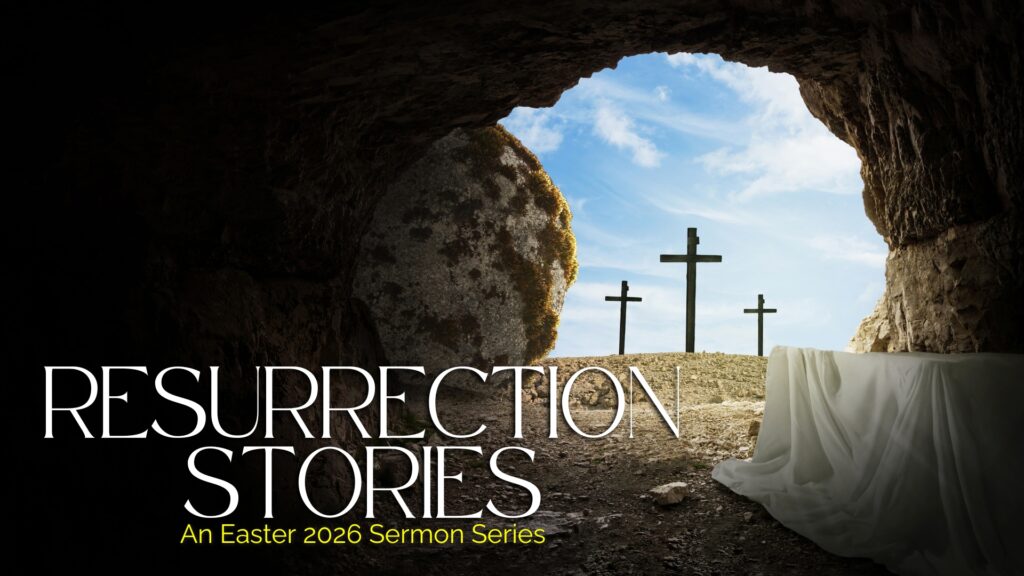
“We are witnesses of everything he did in the country of the Jews and in Jerusalem. They killed him by hanging him on a tree, but God raised him from the dead on the third day and caused him to be seen. He was not seen by all the people, but by witnesses whom God had already chosen—by us who ate and drank with him after he rose from the dead. He commanded us to preach to the people and to testify that he is the one whom God appointed as judge of the living and the dead.” (Acts 10:39-42)
The season of Easter is 50 days and runs from Easter Sunday through Pentecost. In much the same way that the season of Epiphany provides an intentional period of time to allow the wonder of the Incarnation to settle on our souls, the season of Easter provides the same for the Resurrection of Jesus Christ. These events (the birth and resurrection of Jesus) are momentous enough that they warrant their own particular days, but it takes time to begin to realize how truly transformative they were — for ourselves and for the world.
It can be easy for us to rocket past the stories of the appearances of Jesus after the Resurrection. Each Gospel only gives a chapter or two to them (Mark skips them altogether, mentioning only the empty tomb). But that brevity does not reduce their importance. All of the Apostles place a lot of stress on the fact that they were eyewitnesses to the Resurrection. John uses the word “see” eleven times in chapter 20 of his gospel. In every one of his sermons in the book of Acts, Peter speaks of having seen Jesus. In 1 Corinthians 15:3, Paul says that the bodily appearance of Jesus to the Apostles is of “first importance,” and goes on to list those appearances. Adding them up, well over 500 people bore first-hand witness to the resurrection of Jesus.
This is important because it means that the resurrection of Jesus Christ from the dead is true. Jesus was fully and truly dead, placed in a sealed tomb for 3 days, and then that stone was rolled away and the tomb was empty. He was not only seen alive, but he was touched and embraced by hundreds of people. It only takes three eye witnesses to attest legally to the truth of something, and here we have over 500 who saw him and dozens who touched him. This is why Paul says that the bodily resurrection of Jesus Christ is “of first importance,” and this is why the Apostles repeatedly state that they saw Jesus alive after His resurrection.
If the resurrection is physically true, then it is the proof that what Jesus said He came to do is spiritually true. The resurrection is the proof that Christ’s atoning sacrifice on the cross was effective, which means that all of our sins have been paid for. The resurrection is the proof that Jesus defeated the power of death and mortality. The resurrection is the proof that because He went from death to life, we too shall move from death to life. The resurrection is the proof that not only do have hope in this life, but also in the life to come. Because He lives, we too shall live. If Jesus was not raised from the dead, then “your faith is futile; you are still in your sins. Then those also who have fallen asleep in Christ are lost. If only for this life we have hope in Christ, we are to be pitied more than all men.” (1 Corinthians 15:17-19)
But, the resurrection stories make clear that Jesus Christ has been raised from the dead. The stories are true. That’s why the Apostles were so excited to tell everyone they could about Jesus. That’s why 2,000 years later we’re still telling everyone we can about Jesus. In the New Testament we find the Apostle’s resurrection stories about Jesus. What is your resurrection story? How have you seen Him in your life? How has He moved you from death into life? In what ways has His resurrection given you strength for today and bright hope for tomorrow? Take some time to reflect on those questions, and go tell someone about Him. The news is good, because the news is true: The tomb is empty, our Savior lives, and because He lives, we too are able to live!
The best stories, though, aren’t just the ones we tell, they’re the stories we live. In Matthew 7, the difference between the wise and foolish builders is whether they followed Jesus obediently. Jesus’ brother James writes, “What good is it, my brothers, if a man claims to have faith but has no deeds? Can such faith save him?” (James 2:14) Paul picks up the idea of moving from death to life and says, “In the same way, count yourselves dead to sin but alive to God in Christ Jesus. Therefore do not let sin reign in your mortal body so that you obey its evil desires.” (Romans 6:11-12) Tell the story of the resurrected Jesus with what you say, but even more with how you live.
Jesus did many other miraculous signs in the presence of his disciples, which are not recorded in this book. But these are written that you may believe that Jesus is the Christ, the Son of God, and that by believing you may have life in his name. — John 20:30-31
Blessings,
Rev. David Garrison

Westminster Larger Catechism Q. 154. What are the external ways Christ uses to bring us the benefits of his mediation? A. The ordinary external ways Christ uses to bring the benefits of his mediation to his church are his regulations, particularly the word, sacraments, and prayer, all of which are made effective for the salvation of his chosen ones.a
a.. Mt 28.19-20, Acts 2.42,46-47, 1Tm 4.16, 1 Cor 1.21, Eph 5.19-20, 6.17-18.
We are a culture that is obsessed with the extraordinary. As Michael Horton writes in his book, Ordinary, “We’ve become accustomed to looking around restlessly for something new, the latest and greatest, that idea or product or person or experience that will solve our problems, give us some purpose, and change the world… Who wants a bumper sticker that announces to the neighborhood, ‘My child is an ordinary student at Bubbling Brook Elementary’?”1 We chase after “mountaintop” spiritual experiences, launch mission and evangelism efforts that will “take this city for Jesus,” believing that the only way to actually make a “real difference” (whatever that means) is to do something, well, extraordinary on behalf of Jesus and the Kingdom of God. I have been wondering lately if we haven’t gotten the extraordinary ends that God is able to achieve mixed up with the ordinary means by which He goes about doing so.
In Reformed theology, the phrase, “the ordinary means of grace” refers to the proclamation of the Word of God, the right exercise of the Sacraments, and the regular practice of prayer. These are the “ordinary,” as in primary but not only, means by which God brings His transforming grace and power into our lives in order to make us into the new creations He intends and desires us to become. As Thomas Vincent explains, “the ordinances are the most usual way and means of conversion and salvation, without the use of which we cannot, upon good ground, expect that any benefit of redemption should be communicated to us.”2 They are also “ordinary” in the sense that there is nothing particularly outlandish or unique about them. The scriptures have existed in their current state for almost 2,000 years. The sacraments make use of everyday items — water, bread, and wine (or juice). Prayer is something we are able to do at any time, in any place; while formal and ritualized prayers have their place and benefit, we can also kneel down beside our bed at night. There is very little that is revolutionary, radical, or groundbreaking about them. And while God certainly works in other ways all the time, His most powerful, effective, and long-lasting works are done primarily through these simple, ordinary means.
What if the same is true for us — as individual followers of Christ, and as a community of people striving to be faithful together? What if our extraordinary God is calling us to ordinary faithfulness, day in and day out, through our regular getting-up-and-going-to-work-or-school lives? Tish Harrison Warren writes,
…what I’m slowly realizing is that, for me, being in the house all day with a baby and a two-year-old is a lot more scary and a lot harder than being in a war-torn African village. What I need courage for is the ordinary, the daily every-dayness of life. Caring for a homeless kid is a lot more thrilling to me than listening well to the people in my home. Giving away clothes and seeking out edgy Christian communities requires less of me than being kind to my husband on an average Wednesday morning or calling my mother back when I don’t feel like it.3
For the past several years, Northminster has not been able to do much that might qualify as “extraordinary.” We see and hear of churches around us doing lots of great things, which is great, but we’re left wondering if God is able to work through an ordinary church like ours. Perhaps striving to be faithfully ordinary is a calling that is equally extraordinary, and perhaps much harder, than anything else. Perhaps, through our ordinary but faithful worship, discipleship and service, our extraordinary God might do a work in us and our community that far exceeds anything we could ask or imagine. Through ordinary people, faithfully and purposefully practicing the ordinary means of grace, God is able to work extraordinary acts of transformation. And maybe, just maybe, that is a radical idea.
When they saw the courage of Peter and John and realized that they were unschooled, ordinary men, they were astonished and they took note that these men had been with Jesus. – Acts 4:23
Blessings,
Rev. David Garrison
1 Michael Scott Horton. (2014). Ordinary : sustainable faith in a radical, restless world. Zondervan. p.11.
2 Vincent, Thomas. A Family Instructional Guide. Electronic edition based on the first Banner of Truth ed., 1980., Christian Classics Foundation, 1996, p. 234.
3 Courage in the Ordinary. (2013, April 3). https://thewell.intervarsity.org/blog/courage-ordinary.html. Accessed 3/11/2026.

“This is what the LORD says: “Stand at the crossroads and look; ask for the ancient paths, ask where the good way is, and walk in it, and you will find rest for your souls.”
— Jer. 6:16
We just wrapped up our Epiphany series on the Aaronic Blessing in Numbers 6:24-26. Through that series, we found that many of our presumptions about how blessing works were turned upside down. We view blessing as transactional — drop your quarter of obedience or good behavior into the vending machine, and God will dispense blessing in your life. Yet God gives the blessing before the people earn it (in fact, He gives it to them while they are rejecting Him!). If we want to keep God’s face turned toward us, we have to make sure we don’t mess up and disappoint Him. But we saw that what God wants from us is for us to rest in Him, to turn our faces toward His face, to listen to what He has to say to us. It seems that God is much more interested in our “being” rather than our “doing.”
I’ve often thought it somewhat ironic how hard it is for us to “be” in Christ. It is just so much easier to “do” for Jesus rather than “be” in or with Him. And yet, we are human beings, not human doings. Back to blessings for a moment, as an example: God blesses us not because of what we have done, but because of who we are. We haven’t earned His blessings, rather He has chosen us as His children and turned His face toward us in grace. We are His children, and so He has chosen to bless us. In the life of the disciple of Jesus Christ, what we do is meant to flow out of who we are, which presents another irony. It is quite possible to spend your life doing things for Jesus without ever being in Him, but when we focus on being in Christ, the doing will naturally and almost automatically flow out of it. Our primary focus as Christians should be, as we said at the end of the ‘Blessed to be a Blessing’ series, on keeping our eyes on Jesus and listening to Him. Simple, but not easy.
Of all the seasons of the Christian calendar, the season of Lent is most associated with the disciplines of the faith, particularly fasting. For many of us, we see Lent as a season of deprivation. Coming at the tail end of winter, when most of us have gotten sick and tired of the dark and cold, the church comes along and says, “Since you’re already miserable, you should give up something that brings you joy (like, say, chocolate) so you can be a little bit more miserable, so you can learn to love God more.” That’s weird, right? But that’s not the intent of Lent at all. Lent comes from an old English word that means “springtime.” When spring comes around, we get about “spring cleaning” — cleaning up the cruft and detritus that’s built up in our homes and yards over the long cold of winter so the new spring growth can burst forth. Lent is an opportunity for spring cleaning of the soul. It’s not about giving up things that bring us joy, but looking for habits that might have taken root that keep us from being with Jesus and getting rid of those things. In their place we learn new ways, new disciplines, that bring us into the presence of our Savior.
Over the course of the 2,000 or so years since Jesus ascended into Heaven, the Church has struggled with this and so developed a series of disciplines, of tools, to help faithful followers of Christ learn how to do those very things. Yes, there’s a third irony: being is more important than doing, so here are some thing to do to help you be. As Richard Foster explains in his classic work, Celebration of Discipline, “God has given us the Disciplines of the spiritual life as a means of receiving His grace. The Disciplines allow us to place ourselves before God so that He can transform us… By themselves the Spiritual Disciplines can do nothing; they can only get us to the place where something can be done.” These disciplines provide something of a path toward spiritual growth, of teaching us how to keep our eyes on Jesus so we can listen to Him.
Through the season of Lent, we’ll focus on six particular disciplines: fasting — the pathway to spiritual nourishment; simplicity — the pathway to spiritual riches; fellowship — the pathway to love; worship — the pathway to God’s presence; meditation — the pathway to Scripture; and prayer — the pathway to spiritual intimacy. In addition to the Sunday messages, we’ll provide a study guide for you to use through the week to learn more and provide opportunity to being practicing that week’s discipline. It is our hope and prayer that as we intentionally spend time being with Jesus over the season of Lent, we will find ourselves living more of a life that reflects His love and grace into the lives of those around us.
“I am the vine; you are the branches. Whoever abides in me and I in him, he it is that bears much fruit, for apart from me you can do nothing. If anyone does not abide in me he is thrown away like a branch and withers; and the branches are gathered, thrown into the fire, and burned. If you abide in me, and my words abide in you, ask whatever you wish, and it will be done for you. By this my Father is glorified, that you bear much fruit and so prove to be my disciples.” — John 15:5-8
Blessings,
Rev. David Garrison

Even if your eyesight is worse than mine, for the next couple weeks you’ll be seeing hearts everywhere you look. You’ll see candy boxes shaped like hearts. You’ll see candy shaped like hearts. You’ll see a seemingly unceasing flow of ads adorned with hearts flowing across whatever screen has your focus at the moment.
Why? Because Valentine’s Day is coming. The attendant advertising reinforces the cliched notions that our emotions are centered in our hearts and that love instinctively and effortlessly flows from every human heart. So, if we just see enough hearts (and buy enough candy and greeting cards), love will fill the earth and we’ll live happily after.
Okay …
There’s a reason Valentine’s Day isn’t found on the liturgical calendar of the Christian Church: The Bible sees the human heart as representing something far beyond Hallmark and Whitmans sentimentality. Scripture speaks of the heart as the core of a person’s being. The Bible describes the heart as the seat of human thinking, willing, and feeling. (Yes, the Bible recognizes the value and validity of rightly ordered affections.) Even more important, the Bible speaks about the heart as the place where our character is shaped and where our response to God is formed. As we’ll see below, our heart is the source of our speech.
But first, it’s been 33 years since Daniel Patrick Moynihan published an article titled Defining Deviancy Down.[1] Moynihan, a Democrat and devout Catholic, taught at Harvard, served four U.S. presidents, and served four terms as a senator from New York. In this seminal essay, he observed that “deviancy – measured as increases in crime, broken homes, and mental illness – reached levels unimagined by earlier generations. … Actions once considered deviant from acceptable standards became, almost immaculately, within bounds.”2 His article was incisive and prophetic.
Given his chosen topics, Moynihan didn’t discuss an area where cultural decline is especially evident today – our speech. Last year, Virginia elected an Attorney General who insisted he was serious about killing a political opponent and his children.3 This year, a candidate for Ohio Attorney General is telling everyone who will listen how he plans to kill President Trump.4
When did causing children to die in their mother’s arms, just to change the opinion of a political opponent, become “within bounds?” How long have we been sliding down a slippery slope to have reached a place where planning the execution of a sitting president becomes an acceptable plank in a political platform? Is there anything anyone can do to reverse the trend?
To be sure, some have tried. But coarse discourse can’t be smoothed over by increasing the ranks and authority of the Speech Police. Throughout history, coordinated efforts to eliminate free speech have failed everywhere they’ve been tried. And they always will. That’s because speech doesn’t start with our tongues. Rather, it begins in our hearts. Jesus said, “For out of the abundance of the heart the mouth speaks” (Matt. 12:34).
The way to change speech is to change hearts. So, perhaps the Church might want to take another look at all the hearts that will circulating in the run-up to Valentine’s Day.
Valentine’s Day is indeed a cultural custom. But I wonder: Could the Church co-opt the date but change the custom? What would happen if, in the coming years, God’s people were to use Valentine’s Days intentionally to examine the words we’ve spoken or written – edifying and unedifying – in the past 12 months. What might change if we gathered together, or sat silently alone, examined our hearts, and thought about all the words we might use in the year ahead?
What differences might such explorations of our own hearts make in each of our lives, in the life of this church, this community, this country?
[1] The American Scholar, vol. 62, 1993, pp. 17-30.
2 Kevin Warsh, Defining Deviancy, https://www.federalreserve.gov/newsevents/speech/warsh20090616a.htm.

Turn your eyes upon Jesus,
look full in his wonderful face;
and the things of earth will grow strangely dim
in the light of his glory and grace.— Helen Lemmel, “Turn Your Eyes upon Jesus”, The Worshipping Church Hymn #452
I have a friend who can’t drive anywhere without using his GPS. He uses it to get everywhere, even the grocery store. While perhaps not to that extent, most of us have become very dependent on these features of our cell phones. It’s wonderful not only to be told when and where to turn, but how long it will take to reach your destination and what traffic problems might be along your route. This is all coming from a device that fits in our pocket. Technology is an incredible thing. Pretty much anywhere I go, my phone can always tell me exactly where I am and where I need to go to reach my destination.
When we lived in St. Louis, the street we lived off was shut down as they tore it up and replaced it. This project took several months, and they put a “Road Closed to Through Traffic” sign at the nearby intersections. In spite of the sign and the clear evidence of construction (the lack of asphalt being a key clue), each day dozens of cars tried to get through. After all, that was the route their GPS was telling them to take, so they had to go that way. Our technological tools are amazing, and usually reliable, but should not be trusted blindly.
Over the past few years, our technological tools have advanced to the point where we can no longer trust the information we’re being given. Photoshop has been able to alter photographs digitally for a long time, but now we’re able to do the same thing with video, and it is becoming increasingly difficult to spot the fakes. Artificial Intelligence tools have ripped open Pandora’s Box so that any and every one can create fake images and videos. Altered and edited photographs and videos are being distributed not just by questionable sources, but supposedly trustworthy ones as well. News media, government agencies, and of course social media spread, and sometimes create, these fake images and videos with nary an apology or regret. How are we to find our way?
In light of the long arc of human history, GPS is still a very new technology. It’s hard for me to fathom being able to get anywhere without it, but we’ve only been doing so for a few decades. For most of human history, explorers had to rely on hand-drawn maps and the stars to help them figure out where they were and where they were going. It was easy to get lost, but if you did, you could just look up at night and figure it out. Even though the stars moved throughout the night, there was always one that stayed put. Polaris, the north star. Once you located Polaris, you could figure out where you were and navigate from there. Using Polaris as a navigational tool is about as old school as you can get, but as they say, “there ain’t no school like the old school.”
In an age of dis- and misinformation, when we can not trust our technological tools, the media, or even government sources, the Christian can, and should, hold fast to the only north star we’ve ever had, Jesus Christ. He is “the way, the truth, and the life” (John 14:6). When we don’t know which way to go, we turn to Jesus who says, “follow me.” (Mark 1:17) When we don’t know what is true or false, we listen to Jesus who says, “For this purpose I was born and for this purpose I have come into the world—to bear witness to the truth. Everyone who is of the truth listens to my voice.” (John 18:37) When we don’t know how to live, Jesus reminds us that “I came so they can have real and eternal life, more and better life than they ever dreamed of.” (John 10:10 MESSAGE) In the same way that Polaris is always in the same place in the sky, Jesus is “the same yesterday and today and forever” (Hebrews 13:8). If the most reliable sources are the oldest, well, Jesus is the one who hung Polaris in the sky at the dawn of time. That which is truly good, and true, and beautiful, will look like Jesus, sound like Jesus, and act like Jesus.
The problem of disinformation is only going to get worse. The technological tools we’ve come to rely on are going to continue to misdirect us. Instead of doomscrolling on our phones, we need to “fix our eyes on Jesus” (Hebrews 12:2) and “look full in his wonderful face.” Immerse yourself in the Word of God by reading the Bible daily and spending time in prayer. If we spend more time looking at the face of Jesus instead of the glare of our devices, then we will know what is true and what is not, for we will beholding the Face of Truth Himself. When you can’t trust anything else, trust in Jesus all the more.
Let us fix our eyes on Jesus, the author and perfecter of our faith, who for the joy set before him endured the cross, scorning its shame, and sat down at the right hand of the throne of God. Consider him who endured such opposition from sinful men, so that you will not grow weary and lose heart. — Hebrews 12:2-3
Blessings,
Rev. David Garrison

Were there angels in heaven who kept records of such things, I suspect most of us one day would be amazed to learn how often we thought, yet how little we knew, about time.
Please don’t take that as a criticism. The concept of time has long perplexed poets, painters, philosophers, physicists, and those of us who persistently look up at a wall or down at our wrist (or our phone) to learn what time it is. It might seem that attempts to learn what time it is presuppose that someone, somewhere, has determined what time is. But that presupposition is optimistic.
Most of us have a deeply intuitive sense not only that time exists, but that it matters. Even if we can’t precisely define it, we continually experience it. And many individuals, coming from many different starting points, have tried to express their perceptions about time.
Poets, going at least as far back as William Shakespeare, eloquently survey the effects of time on human beings. Often, but certainly not always, poets portray time as an enemy. The best-known painting of the Surrealist Salvador Dali, formally titled The Persistence of Memory, is more popularly known as Melting Clocks. Years after finishing the painting, Dali addressed the wide range of meanings ascribed to the work by saying even he didn’t know what it meant.
Then there are physicists and philosophers who don’t believe there’s any such thing as time. Some modern physicists use Albert Einstein’s theory of relativity to argue that in space-time, concepts such as past, present, and future are meaningless. A century earlier, the philosopher Immanuel Kant had argued that temporal order is found only in an individual’s mind and that time does not objectively exist.
The Bible takes a different approach. Although both Hebrew and Greek have several words properly translated “time,” Scripture doesn’t speculate about time’s nature. Instead of arguing for its existence or listing its qualities, the Bible simply assumes that time exists. My broad summary of the biblical view of time is that it’s something like a cosmic canvas across which God’s specific acts in the redemption of his people are sequentially unfurled.
Time is God’s creation and it remains under his direction. As such, not only is time real (contra some philosophers and physicists), time is also very good (contra some poets and painters). According to the Bible, human history, and our individual histories, are moving toward a God-established goal. Time is a gift of God that helps us track our progress. We can look back at the places where we’ve wandered off the path. We can also look ahead to get at least a glimpse of the glory God already has prepared for us.
The advent of a new calendar year is often used by individuals and organizations as an opportunity to look back and to look ahead. Both can be rewarding exercises. As Christians, we can look back and see specific points where we’ve grown in our faith. We can also gain clarity about opportunities for future growth. But, as Christians, I think our greatest joy comes from looking ahead. For there we see a God “with whom there is no variation or shadow due to change” (James 1:17). And there we see our Savior, Jesus Christ, who “is the same yesterday and today and forever” (Heb. 13:8).
Happy New Year.

And Mary said, “My soul magnifies the Lord,
and my spirit rejoices in God my Savior,
for he has looked on the humble estate of his servant.” — Luke 1:46-48
There’s a tension lurking underneath the surface of our celebrations of Christmas each year. It’s one of those things that can be easy to overlook, but once you see it, it’s really hard to unsee it. In the birth of our Savior, Jesus Christ, we celebrate the fulfillment of all of the prophecies in the Bible that speak to the redemption of all of humanity and creation. Over the course of this month, we will sing of joy, while many are filled with sorrow and struggle with depression. We sing of peace, while wars rage around the world and in our hearts. We sing of love, and yet are surrounded by so much hate. We sing of hope, but wonder, deep down, if anything will ever change. Wasn’t Jesus supposed to change all of this?
Consider Mary’s song of joy of what God has already done in The Magnificat: “He has shown strength with his arm; he has scattered the proud in the thoughts of their hearts; he has brought down the mighty from their thrones and exalted those of humble estate; he has filled the hungry with good things, and the rich he has sent away empty.” (Luke 1:51-53) I look around the world today, and I see a lot of proud and mighty people still boasting. I see those of humble estate still struggling. The hungry are still starving; the rich are still hoarding. We know Jesus accomplished these things, because the Bible is very clear that He did, but why is there still so much suffering and injustice, sin and brokenness? It is the season of Advent that helps provide an answer.
In her magnificent book, Advent: The Once & Future Coming of Jesus Christ, Fleming Rutledge writes,
Karl Barth exclaimed, “What other time or season can or will the Church ever have but that of Advent!” This illuminates the present dimension of the season. It locates us correctly with relation to the first and second comings of Christ. Advent calls for a life lived on the edge, so to speak, all the time, shaped by the cross not only on Good Friday but wherever and whenever we are, proclaiming his death to be the turn of the ages “until he comes” (I Cor. 11:26)… In a very real sense, the Christian community lives in Advent all the time. It can well be called the Time Between, because the people of God live in the time between the first coming of Christ, incognito in the stable in Bethlehem, and his second coming, in glory, to judge the living and the dead. In the Time Between, “our lives are hidden with Christ in God; when Christ who is our life appears, then we also will appear with him in glory” (Col. 3:3–4). Advent contains within itself the crucial balance of the now and the not-yet that our faith requires. (Pg 7)
Everything the Bible says about what Jesus accomplished in His incarnation is absolutely true. God is now with us in Jesus Christ. The power of sin and death has been broken. The proud have been brought down and the humble lifted up. Prisoners freed. The blind given sight. The lost found. The broken soul made whole. And yet. And yet, all of these things are also yet to be completed. As Jesus said, “The time is fulfilled, and the kingdom of God is at hand; repent and believe in the gospel.” (Mark 1:15) Jesus has absolutely accomplished all of these things, but He has not yet completed all of these things. Advent is the season that reminds us of this tension and invites us into it. It is the season of, as Rutledge said, “the Time Between.”
When Jesus returns, the Kingdom of God will finally be consummated. The work begun with His first coming will be completed. That which has happened now in part will then be completed in full. It is the season of Advent that keeps our focus and our hope on that great and wonderful day. Advent doesn’t merely acknowledge the tension of the already/not yet, it embraces it. Just as in the incarnation our Savior came to earth and met us where we are, the season of Advent reminds us that He is still doing the same today, and that one day He will finish what He started.
This Advent, we’ll take a look at how each of the Gospels tell the story of the birth of our Savior (except for Mark, who doesn’t include a birth narrative), and how each points us to His return. We’ll begin our Advent celebration with a service of prayer, scripture and song, using Mary’s Magnificat as our guide to prepare our hearts and our souls to worship deeply and well this holiday season. As you prepare for and celebrate the birth of our Savior, keep your eyes focused on His return. Joy to the world, the King is coming!
For we know in part and we prophesy in part, but when the perfect comes, the partial will pass away. When I was a child, I spoke like a child, I thought like a child, I reasoned like a child. When I became a man, I gave up childish ways. For now we see in a mirror dimly, but then face to face. Now I know in part; then I shall know fully, even as I have been fully known. (1 Cor. 13:9-12)
Blessings,
Rev. David Garrison