
For as long as I can remember, I have loved the music of the Christmas season. From Linus and Lucy Can Rock to You’re a Mean One, Mr. Grinch and from Frosty the Snowman to Rudolph, the Red-Nosed Reindeer, music from the animated specials of my childhood still brings a smile to my face.
Through the years, I have added an appreciation of more substantial works, including Antonio Vivaldi’s Gloria and George Friedrich Handel’s Messiah. Although they were written about 300 years ago, both are still widely performed when Christmas time is here, eloquent evidence of music’s ability to convey profound truths to human souls.
And I never tire of playing or singing Christmas carols. My favorite is Angels We Have Heard on High. The melody comes from a traditional French piece, “The Angels in Our Countryside.” “Traditional” is one way musicians say, “We have no idea who wrote this tune.”
The author of the 10 original verses is equally unknown. We do know that in 1860, these verses were translated into English by James Chadwick, a Roman Catholic bishop from England. I was surprised when I learned that it was not until 1966, when the American composer Austin Lovelace was preparing to include it in a new United Methodist hymnal, that this centuries-old carol was first given the title “Angels We Have Heard on High.”
One of my earliest musical memories is learning to sing this carol for my home church’s Christmas pageant. This annual event was the standard small church bathrobe drama, complete with shepherds and angels, wise men and a plastic baby Jesus. But with each tableau, the Junior Choir sang a verse or two from an appropriate carol. When we got to Angels We Have Heard on High, I was asked to sing the alto line for the refrain.
That was a revelation.
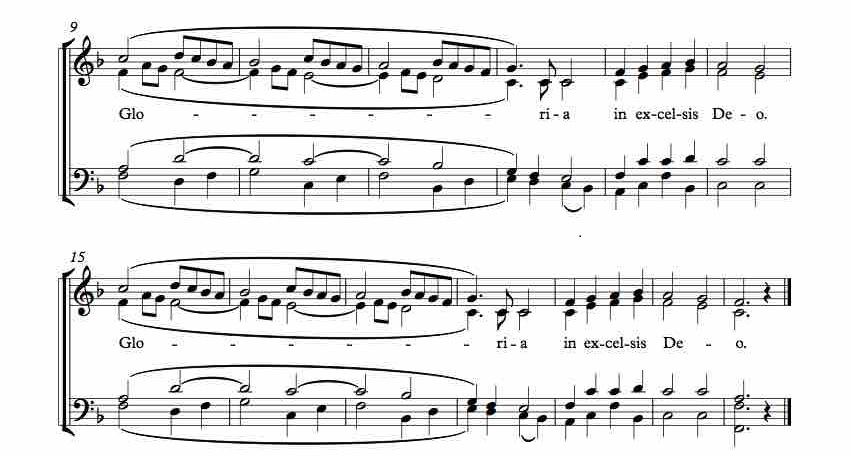
As the carol’s refrain began, the sopranos held their note for several beats while the altos sang shorter notes below them. Then we held a long tone while the sopranos kept changing notes above us. I was hooked. It would be years before I learned that the technical term for that musical procedure is “polyphony,” literally, “many voices.” It took me even longer to recognize that this compositional technique provides an ideal way to set the text of the carol’s refrain, which is taken from Luke 2:13-14:
And suddenly there was with the angel a multitude of the heavenly host praising God and saying,
“Glory to God in the highest,
and on earth peace among those with whom he is pleased!”
By definition, a multitude of angels would include many voices. Using what a former pastor called my “sanctified imagination,” I can imagine that the voices of the heavenly host ranged from low to high, each with its own distinctive timbre. And while I can’t imagine what that heavenly choir sounded like when they praised God from the sky, I’m sure that what the shepherds heard was glorious and that it glorified God in the highest.
As together we begin this new Christian year, journeying through Advent to Christmas with the music of the season ringing in our years, let me encourage you to listen a bit more carefully to the carols you’ll hear and sing. For even though we know them all by heart, if we pay a little more attention to both the words and the music, we just may find our souls refreshed in unexpected ways.
Gloria in excelsis Deo.
